Comparing dynamic viewpoint control techniques for teleoperated robotic welding in construction

April 1, 2025·
Sungboo Yoon
Sungboo Yoon
· 0 min read
Abstract
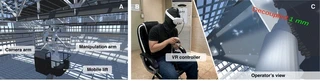
Dynamic viewpoints offer effective visual feedback in teleoperation for construction, where tasks often require precise manipulation during frequent viewpoint adjustments. However, the comparative performance of various dynamic viewpoint control techniques remains unclear. This paper investigates the impact of dynamic viewpoint control techniques on task performance and user experience during teleoperation in construction. A user study was conducted in a remote welding-at-height scenario with 20 participants, including experienced welders and university students, to compare five techniques: (1) coupled vision-motion, (2) decoupled vision-motion with hand or head motion-based control, and (3) hybrid vision-motion with manual or automatic switching. Results showed that decoupled vision-motion with head motion-based control outperformed other techniques in task efficiency and user preference. Hybrid vision-motion with manual switching was more effective than decoupled vision-motion in contexts involving occlusions, reducing physical demand and enhancing welding quality. Based on these findings, guidelines are proposed for viewpoint control in teleoperated construction robots.
Type
Publication
Automation in Construction
publications
Sungboo Yoon
Authors
PhD Candidate @ Seoul National University

Hello! I am a fifth-year Ph.D. candidate in the Department of Architecture & Architectural Engineering at Seoul National University. I am fortunate to be advised by Professor Changbum R. Ahn, and I am a member of the Construction Engineering & Management Lab. My research interests include construction robotics, human-robot interaction, and robot learning.

I previously completed both my bachelor’s and master’s degrees in Architectural Engineering at Seoul National University, where I conducted research on modular construction and human-robot interaction under the advisement of Professor Moonseo Park.

I am honored to be a recipient of the Basic Science Research Program (Ph.D. Fellowship) from the National Research Foundation of Korea (NRF).

Currently, I serve as a student coordinator of a joint project funded by the Ministry of Land, Infrastructure and Transport & Ministry of Trade, Industry and Energy, South Korea, on developing a multipurpose robotic platform and XR-based human–robot collaboration system for construction work at height. If you are interested, please visit this page for more details.